XLOOKUP vs VLOOKUP: Key Differences, Examples, and Which One Is Better?
Finding one piece of information in a spreadsheet shouldn’t feel like searching for a needle in a digital haystack. Yet […]
Read article →GitHub alone won’t cut it when your team spans 6 time zones. PRs sit for 18 hours because the one […]
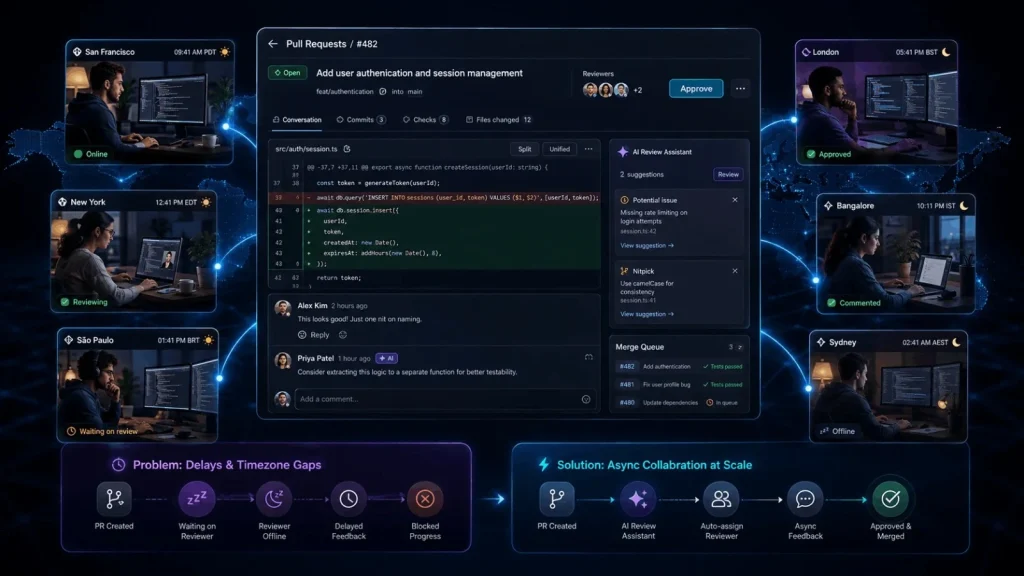
GitHub alone won't cut it when your team spans 6 time zones.
PRs sit for 18 hours because the one engineer who owns that service is asleep in Lisbon. Reviews come back at 2am. Code review turns into timezone chicken, where everyone waits for the right person to show up.
The tools below fix different parts of that problem. Pick based on where your actual friction is.
Most teams treat this as a tooling gap. It's a routing and accountability gap that tooling can make better or worse.
The average PR sits open for 4.5 hours on co-located teams. For distributed teams, that number climbs past 24 hours. The gap lives in 2 places: who reviews what, and when they find out they're supposed to.
This is where most teams start and stay. For distributed teams, the native product is adequate. The features people underuse:
CODEOWNERS routes reviews to whoever owns a given path in the codebase. No more "who should review this?" Slack threads at 9am when the author already went offline.
Required reviewers + branch protection sets a floor. PRs can't merge without 2 approvals. That bakes a review SLA into the repo config instead of relying on someone to remember.
Merge queues (GitHub Enterprise) handle the race condition where 3 approved PRs all try to land at once and break main. Worth enabling past 10 engineers.
Where GitHub falls short: zero visibility into review latency. You can't see that one engineer's PRs sit 3x longer than others, or that reviews from Berlin take 22 hours while reviews from São Paulo take 4. For that, you need something on top.
LinearB sits on top of GitHub or GitLab and measures what GitHub won't: review time, merge time, time to first comment, pickup time by reviewer and timezone.
The reviewer routing is smarter than CODEOWNERS. It looks at who actually reviews code in a given directory, not just who's listed. It also surfaces PR bottlenecks: which PRs are going stale, which engineers are overloaded, which ones have 0 reviews after 8 hours.
You can set review SLAs and get Slack pings when PRs breach them. For a team split across EST and APAC, that matters. A PR sitting unreviewed for 24 hours is a full day of blocked work.
Enterprise pricing. Worth it past 20 engineers when PR cycle time is directly costing shipping speed.
Graphite solves one specific problem: stacked PRs.
If your team runs trunk-based development and ships small changes daily, it's excellent. Engineers stack 4-5 small PRs on top of each other and reviewers work through them as a chain, each one taking 5-10 minutes. The alternative, one 800-line PR, sits open for 3 days because reviewers bounce off it.
For distributed teams, PR size matters more than tooling in most cases. A 50-line PR gets reviewed async in 20 minutes by someone in a different timezone. An 800-line PR needs synchronous back-and-forth that drags out across 2-3 calendar days.
The review queue UI is also cleaner than GitHub's native PR list. Engineers see exactly what needs their attention without scanning 40 open items.
CodeRabbit runs an automated first pass on every PR before human reviewers touch it. It catches style issues, bugs, missing tests, and logic problems.
For distributed teams, this has real async value. A reviewer in Singapore shouldn't spend 20 minutes on nitpicks a bot can catch overnight. They should spend those 20 minutes on the architectural decision the PR is actually making.
It integrates directly into GitHub and GitLab, commenting inline. Comment quality is decent, not airtight. Security tradeoffs and structural decisions still need real reviewers.
The async gain: engineers in an earlier timezone push a fix, get automated feedback immediately, and address issues before the timezone-lagged reviewer wakes up. That cuts one full review cycle out of the timeline.
Free tier available. Enterprise pricing for private repos at scale.
Reviewpad handles reviewer routing, PR labeling, merge conditions, and workflow automation through a YAML config checked into your repo.
You write rules like: "if this PR touches the payments directory, require 2 senior engineers and block merge until CI passes for 10 minutes." It runs those rules on every PR.
The time-based routing is why most distributed teams pick it. PRs opened after 5pm EST route to the APAC team first, which is a 12-hour head start on review instead of 12 hours of dead air.
Setup takes a few hours. Maintenance is low after that.
If you want routing and pings without paying for a dedicated tool, the native GitHub + Slack integration covers basic notifications. You can set up channels per repo and route PR alerts there.
Engineers learn to ignore Slack notification channels fast. A #prs-backend channel becomes the place everyone mutes by week 3.
Fine for teams under 10 engineers. Past that, you'll spend more time on Slack meta-work than actual code review.
Measure your actual PR cycle time first. GitHub won't surface this natively, but LinearB, Waydev, or a simple CSV export from the API will tell you where the hours go.
PRs sitting 18 hours before first review? Routing and notification.
PRs reviewed quickly but taking 3 days to merge? Merge process and branch protection rules.
The tooling is secondary to knowing which part of the timeline you're actually trying to fix.
For teams under 15 engineers, probably. CODEOWNERS and branch protection handle most of it. Past that, you lose visibility into where the bottlenecks live.
No. Tools like CodeRabbit catch a real category of issues and make human reviewers faster. They can't reason about security tradeoffs or whether a new abstraction will hurt the codebase in 6 months. First pass only.
Smaller PRs move the needle more than any tool. Under 400 lines means any reviewer in any timezone gets through it in one sitting. Explicit reviewer assignment at PR creation matters too: optional routing means reviewers assume someone else will pick it up. Stale PR pings after a set time threshold finish most of what you need.
Depends on the problem. Graphite for stacked PRs and clean review queues. LinearB for visibility and SLA enforcement. CodeRabbit for automated first-pass review. They solve different parts of the same bottleneck.
Finding one piece of information in a spreadsheet shouldn’t feel like searching for a needle in a digital haystack. Yet […]
Read article →
Ever spent 20 minutes searching for an AI conversation that took only two minutes to write? You’re not alone in […]
Read article →
Thinking about changing your hair color but worried you might regret it? We’ve all seen a gorgeous hair shade on […]
Read article →