
XLOOKUP vs VLOOKUP: Key Differences, Examples, and Which One Is Better?
Finding one piece of information in a spreadsheet shouldn’t feel like searching for a needle in a digital haystack. Yet […]
Read article →AI can write the email, summarize the meeting, analyze the spreadsheet, answer the customer, and increasingly take actions across business […]
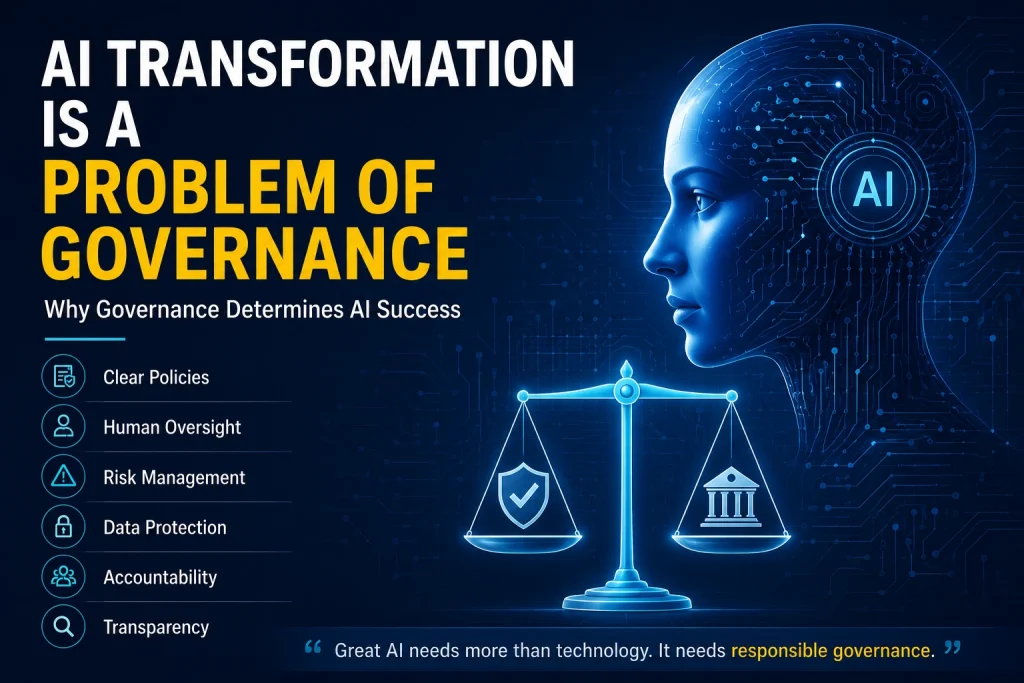
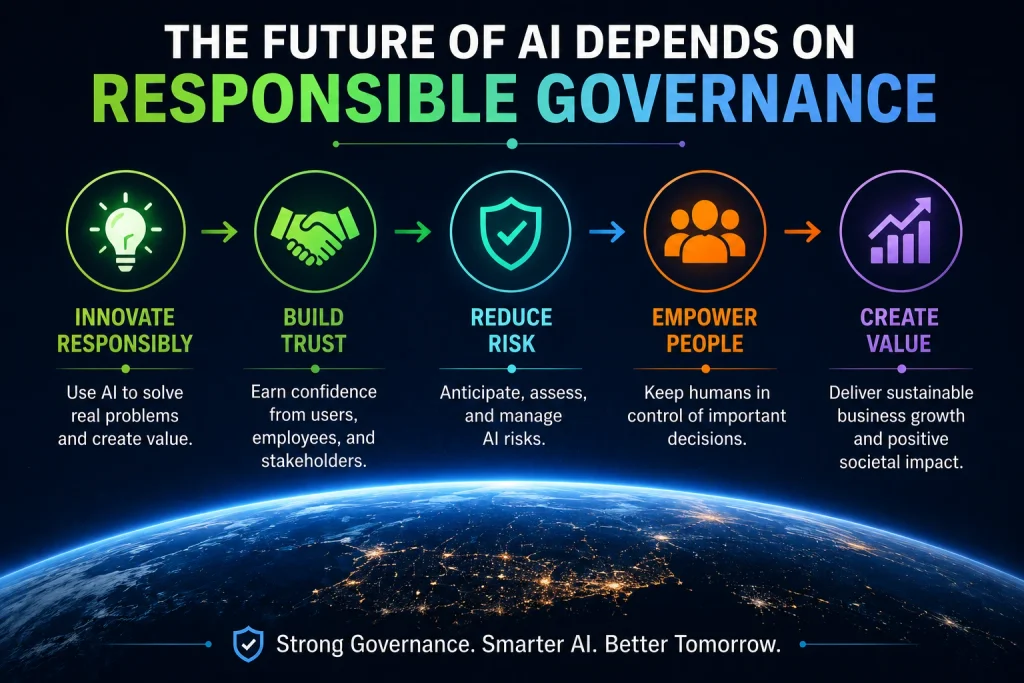
AI can write the email, summarize the meeting, analyze the spreadsheet, answer the customer, and increasingly take actions across business systems.
But there is one question it cannot answer for an organization:
Who is responsible when it gets something wrong?
That question gets to the heart of the idea behind “AI transformation is a problem of governance,” a phrase that has surfaced in Twitter/X conversations and across the wider technology and business debate.
At first, it sounds counterintuitive. AI transformation is supposed to be a technology challenge. Companies need better models, better data, better infrastructure, and employees who know how to use the tools—right?
Those things matter. But once AI moves from an interesting experiment to something that influences real work, the difficult questions change.
Who can use AI with sensitive company data?
Which decisions can be automated?
Who approves an AI system before it reaches customers?
When does a human need to review an output?
Who monitors the system after launch?
And who has the authority to switch it off?
Those are not primarily model questions.
They are governance questions.
The idea does not mean that AI technology is unimportant. It means technology alone cannot produce a successful AI transformation.
A company can buy an excellent AI platform and still have a poor AI strategy.
Why?
Because AI changes more than software. It can change workflows, access to information, decision-making, employee responsibilities, customer interactions, and the speed at which actions are taken.
Imagine a company introduces an AI assistant for customer support.
During a small pilot, the risk may seem manageable. Employees review the responses before sending them.
Then the company connects the same AI to customer records. Later, it is allowed to issue refunds, update accounts, prioritize complaints, and trigger other workflows.
The AI has not simply become “better.”
Its authority has expanded.
At that point, the important question is no longer just whether the model produces good answers. The organization needs to decide what the system is allowed to do, what information it can access, what requires human approval, how its actions are recorded, and what happens when something goes wrong.
That is governance in practice.
Technology conversations on Twitter/X often move quickly from one new model, agent, or product release to another.
That makes sense. New capabilities are visible and exciting.
Governance is less visible.
You cannot make a dramatic demo out of an approval process, an audit trail, a clearly assigned system owner, or a rule specifying when an AI agent must ask a human for permission.
Yet those less glamorous decisions often determine whether an impressive AI prototype can become a dependable part of a real organization.
This explains why the phrase AI transformation is a problem of governance Twitter searches point toward a broader debate rather than simply another AI trend.
The conversation is shifting from:
“What can this AI do?”
to:
“What should we allow it to do, under whose authority, and with what safeguards?”
That is a much more consequential discussion.
Building an AI demonstration has become remarkably accessible.
A team can connect a model to documents, build a chatbot, automate a repetitive task, or prototype an AI agent in days rather than months.
Scaling that experiment across an organization is different.
Consider an AI system that reads incoming invoices and prepares payments.
The technical team may focus on extraction accuracy and automation.
Finance will care about payment controls.
Security will ask what systems and financial information the AI can access.
Legal and compliance teams may want records showing how decisions were made.
Management will want to know whether the system actually saves money.
Employees will want to understand whether they are expected to approve its decisions or merely supervise exceptions.
Suddenly, the challenge is not one AI model.
It is an organizational system involving people, processes, permissions, risks, and accountability.
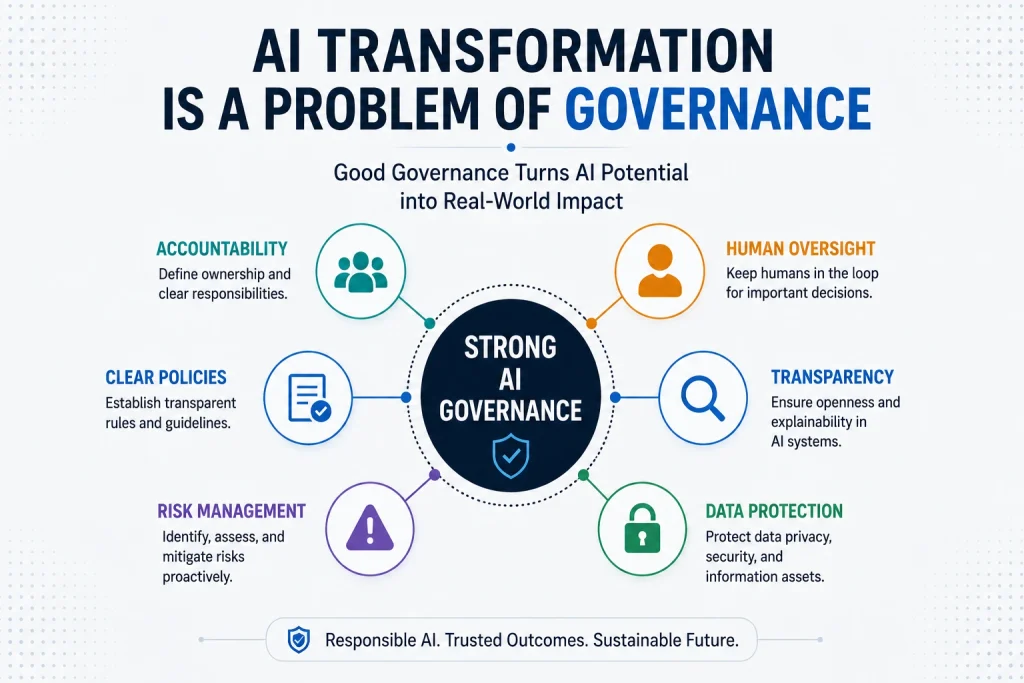
This is where many AI transformation efforts become governance problems.
Every important AI deployment needs an accountable owner.
Not simply the person who configured the model.
Someone needs responsibility for the business outcome and the consequences of using the system.
If an AI recruiting tool produces questionable recommendations, saying “the algorithm selected the candidates” does not resolve the issue.
Organizations still make the decision to deploy the technology.
Ownership therefore needs to be clear before an AI system becomes deeply embedded in a workflow.
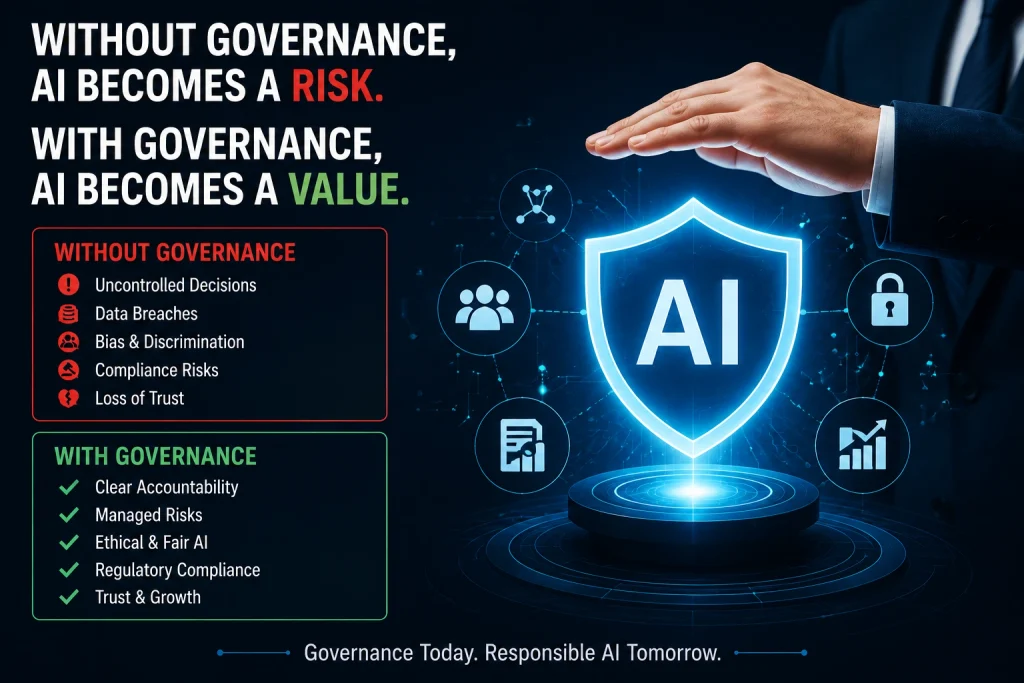
There is an enormous difference between AI that recommends an action and AI that takes the action.
An assistant that drafts an email presents one level of risk.
An agent that independently sends thousands of emails presents another.
An AI system suggesting a refund is different from one that can transfer money automatically.
Organizations need explicit boundaries around authority.
A useful principle is:
The greater the consequence of an AI action, the stronger the control around that action should be.
This allows companies to innovate without treating every use of AI as equally risky.
AI governance is also data governance.
An employee might paste customer information, internal documents, source code, contracts, financial records, or strategic plans into an AI service without fully understanding how that information is processed.
The organization therefore needs practical rules.
Which AI systems are approved?
Which data classifications can be used with them?
Can confidential information leave company-controlled environments?
How long is information retained?
Who can connect an AI agent to internal databases?
A vague instruction to “use AI responsibly” is not enough. Employees need rules they can actually follow during everyday work.
Human oversight does not mean a person needs to approve every AI-generated sentence.
That would eliminate much of the benefit of automation.
Instead, oversight should reflect consequences.
Low-risk tasks such as formatting notes may require little intervention.
A decision affecting employment, finance, safety, privacy, legal rights, or access to essential services deserves much stronger review.
The goal is not to place a human everywhere.
It is to place meaningful human judgment where errors matter most.
AI governance cannot finish on launch day.
AI systems operate in changing environments. Data changes. User behavior changes. Models can be updated. Workflows evolve. New risks appear.
Organizations therefore need monitoring after deployment.
They should know whether an AI system is still performing as expected, whether people are using it in unintended ways, whether incidents are occurring, and whether its original controls remain appropriate.
Governance is not a document created before deployment.
It is an operating process.
One reason people resist the word governance is that it sounds like bureaucracy.
More forms. More committees. More approvals. Less experimentation.
Poor governance can certainly become that.
Good governance should do the opposite.
When employees do not know which tools are permitted, they hesitate—or use them quietly.
When teams do not know what data they can provide to AI, every project becomes a debate.
When nobody knows who can approve a deployment, pilots remain pilots.
Clear governance removes those uncertainties.
A team that knows its boundaries can often move faster than one that has unlimited theoretical freedom but no practical authority.
In that sense, guardrails are not necessarily brakes.
Sometimes they are the road.
Organizations do not necessarily need a huge AI committee before experimenting.
They do need a repeatable decision process.
A practical model can start with four questions:
Establish ownership, policies, responsibilities, and acceptable-use boundaries.
Understand what the AI system does, who it affects, what information it uses, and what could go wrong.
Test performance, reliability, security, bias, privacy implications, and other risks relevant to the particular use case.
Respond to identified risks, monitor the system, document incidents, and change or stop the deployment when necessary.
The important part is not turning governance into a checkbox exercise.
The important part is making responsibility visible.
Generative AI initially became popular through chat interfaces.
A user asked something. AI responded.
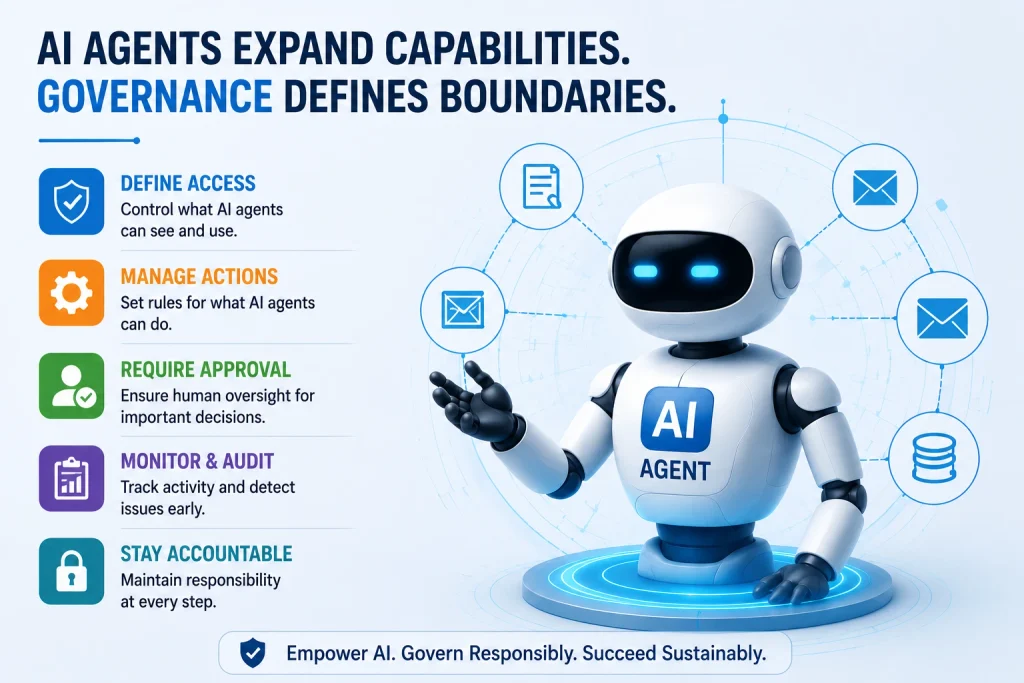
AI agents change that relationship.
An agent can potentially read an email, interpret it, retrieve information, update a database, generate a document, send a response, schedule an event, or trigger another system.
This turns AI from an information tool into an action layer.
And action creates a new governance question:
What authority are we delegating to software?
Before connecting an AI agent to a business system, organizations should know:
As AI becomes more autonomous, governance becomes part of the architecture—not an administrative task added afterward.
Suppose a company wants AI to handle routine customer refund requests.
A weak approach might be:
Let the AI process refunds and see how well it performs.
A governed approach would be more deliberate.
The company might allow automatic refunds below a defined threshold, require human approval above it, prevent the AI from changing bank information, log every transaction, restrict access to only necessary customer data, and automatically flag unusual patterns.
The second system may appear more constrained.
In reality, it is much easier to scale because the organization knows the limits of the system and the responsibilities surrounding it.
That is the difference between simply using AI and building an AI operating capability.
AI transformation is often discussed in terms of productivity.
How many hours can it save?
How many processes can it automate?
How much content can it generate?
Those are useful measurements, but transformation depends on another resource: trust.
Employees need confidence that AI will not expose information or make unexplained decisions on their behalf.
Customers need confidence that automation will not remove accountability.
Executives need confidence that AI investments create measurable value without introducing uncontrolled risk.
Regulators and other stakeholders may need evidence that important systems are being managed responsibly.
Trust cannot be created by telling everyone that AI is trustworthy.
It comes from visible accountability, sensible controls, transparency, testing, and the ability to intervene when something fails.
The most important AI transformation may not happen inside the model.
It may happen inside the organization around it.
Companies will need to rethink who can automate workflows, how employees interact with AI, how access is granted, how automated decisions are reviewed, how risks are measured, and how responsibility is assigned.
The organizations that handle those questions well will not necessarily be the ones with the most AI tools.
They will be the ones that can move from experimentation to dependable deployment without losing control of what their systems are doing.
So, is AI transformation really a problem of governance?
Technology remains essential. Models need to work. Data needs to be usable. Infrastructure needs to perform.
But once AI becomes capable enough to influence real decisions and take real actions, technological capability is only the beginning.
The harder questions become:
Who decides? Who approves? Who monitors? Who can intervene? And who is accountable?
Those questions determine whether AI remains an impressive collection of experiments or becomes a sustainable part of how an organization operates.
That is why the discussion behind “AI transformation is a problem of governance” on Twitter/X deserves attention.
The next phase of AI adoption will not be defined only by what machines become capable of doing.
It will also be defined by how intelligently humans decide what machines are allowed to do.
It means that successful AI adoption depends on more than choosing powerful models or tools. Organizations also need clear rules for accountability, data access, human oversight, risk management, and the decisions AI systems are allowed to make.
AI governance helps businesses define who is responsible for AI systems, how sensitive data can be used, which decisions require human review, and how AI-related risks should be monitored. Clear governance can also make it easier to scale AI beyond small experiments.
Not entirely. Technology is an important part of AI transformation, but organizational structure, policies, employee responsibilities, data management, and accountability can become equally important as AI moves into real business workflows.
Discussions on Twitter/X and across the technology community increasingly focus not only on what AI can do, but also on who controls it, how much authority AI agents should receive, and who remains accountable for their actions. This broader debate is why AI governance has become closely connected with AI transformation.
Common elements include clear ownership, AI policies, risk assessment, data controls, human oversight, transparency, security, monitoring, documentation, and procedures for responding when an AI system behaves unexpectedly.
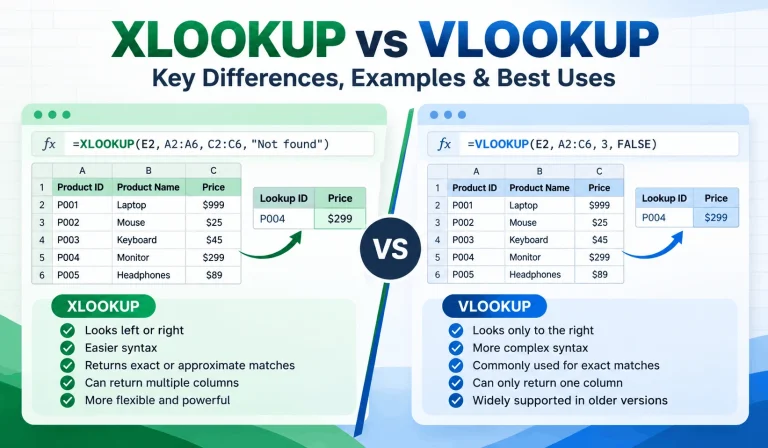
Finding one piece of information in a spreadsheet shouldn’t feel like searching for a needle in a digital haystack. Yet […]
Read article →
Ever spent 20 minutes searching for an AI conversation that took only two minutes to write? You’re not alone in […]
Read article →
Thinking about changing your hair color but worried you might regret it? We’ve all seen a gorgeous hair shade on […]
Read article →