
AI Chatbot Conversations Archive: How to Save, Find, and Manage Chats
Ever spent 20 minutes searching for an AI conversation that took only two minutes to write? You’re not alone in […]
Read article →What beats a rock? If you grew up playing Rock Paper Scissors, your first answer is probably paper. But what […]
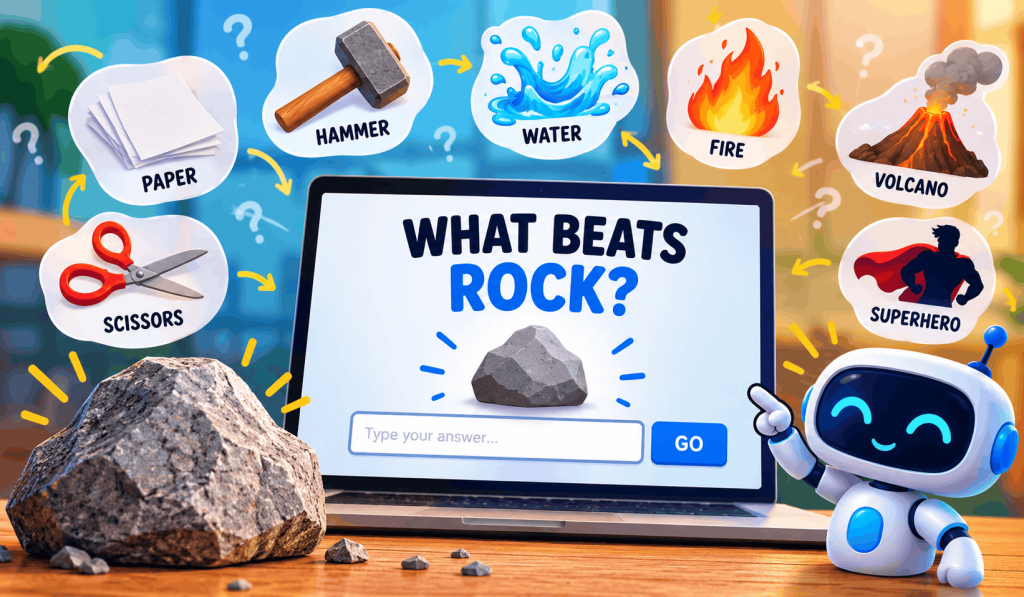
What beats a rock? If you grew up playing Rock Paper Scissors, your first answer is probably paper. But what if you could use a hammer, a volcano, or even a fictional superhero instead?
That's where the What Beats Rock game gets interesting.
This online game takes a familiar childhood challenge and turns it into a creative guessing adventure. Instead of choosing from three options, you can suggest almost anything. An AI system then decides whether your answer can defeat the previous item.
Sounds easy, right? It is, until you have to explain what beats your last answer.
Let's explore how the game works, where to play it, and how to build a longer chain of successful answers.
What Beats Rock is an online, AI-powered word game inspired by Rock Paper Scissors. Players must name something that can defeat the object or concept shown on the screen.
The game starts with a rock.
You enter something that could beat it, and the AI evaluates your suggestion. If the game accepts your answer, that answer becomes the next challenge.
For example, you might start with paper because paper covers rock in traditional Rock Paper Scissors.
The next question becomes: What beats paper?
You could answer scissors. If the AI accepts it, you must then find something that beats scissors.
The process continues as long as your answers pass the game's checks.
Unlike traditional Rock Paper Scissors, the game doesn't limit you to three choices. Everyday objects, natural forces, scientific ideas, and imaginary characters can all become possible answers.
That freedom makes the game entertaining, unpredictable, and occasionally ridiculous.
After all, figuring out what beats a giant asteroid isn't exactly a normal Tuesday activity.
If you're curious about how AI makes decisions in games, explore our guide on how artificial intelligence works in games.
You don't need complex instructions or gaming experience to get started. The original game runs in a web browser and has a straightforward interface.
Here's how to play.
Open WhatBeatsRock.com.
The main screen displays the question "What beats rock?" alongside a text field where you can enter your response.
Think of something that could defeat a rock.
Paper is the classic choice, but you can try a different idea.
For example, a sledgehammer could break a small rock. Whether the game accepts a particular answer depends on its AI evaluation.
Type your answer and press the GO button.
The system determines whether your suggestion beats the current item.
If your answer succeeds, the game moves to the next challenge.
Now you must beat your previous answer.
Suppose you entered paper and the game accepted it. Your next task involves finding something that defeats paper.
Scissors would be a familiar choice because scissors can cut paper.
You can also experiment with less obvious possibilities.
Keep answering and see how far you can go.
The official website displays a score and provides access to a leaderboard. You can also sign in to save scores and access additional account features.
Remember that a creative answer isn't automatically a correct one. The AI still needs to accept the relationship between your suggestion and the previous item.
The basic concept is simple: each new answer must beat the previous one.
However, several details make the experience different from an ordinary guessing game.
You can't simply enter an unrelated word and expect to continue.
Your answer must describe something capable of defeating, destroying, overpowering, or otherwise overcoming the current item.
Consider these examples:
| Current Item | Possible Answer | Reasoning |
|---|---|---|
| Rock | Paper | Paper covers rock in the classic game. |
| Paper | Scissors | Scissors cut paper. |
| Scissors | Heavy machinery | Powerful machinery could damage scissors. |
| Fire | Water | Water can extinguish many fires. |
| Ice | Heat | Heat can melt ice. |
These examples explain possible relationships, not guaranteed results from the live game.
The AI may interpret your choices differently depending on context.
The standard game's challenge involves finding new ideas instead of repeating earlier responses.
That means you can't endlessly rotate between rock, paper, and scissors.
You need fresh answers as your chain grows.
The game uses an AI system to evaluate whether your proposed answer beats the previous one.
This introduces flexibility, but it also creates uncertainty.
An answer that seems obvious to you might fail the system's evaluation.
Similarly, a surprising answer might succeed because the AI recognizes a reasonable connection.
The important thing is to understand the relationship behind your choice rather than assuming that every imaginative idea will work.
Paper remains the classic answer. However, this game encourages you to think beyond the traditional rules.
Here are several ideas worth considering.
Paper beats rock in traditional Rock Paper Scissors because it covers the rock.
It's a familiar starting point and creates an easy follow-up question.
What beats paper? Scissors, of course.
A sledgehammer can break certain rocks when someone applies enough force.
This makes it a reasonable alternative to paper.
However, the outcome depends on factors such as the rock's size, material, and the force applied.
Water can gradually wear down rock through erosion.
According to the U.S. Geological Survey, flowing water plays a major role in erosion and the movement of sediment.
It isn't an instant victory, but it's a scientifically reasonable idea when time is part of the explanation.
Strong heat can melt some rock materials.
The USGS explains that molten rock beneath Earth's surface is called magma. When it reaches the surface, it is called lava.
This makes extreme heat another interesting idea, although the temperatures and conditions matter.
What about a superhero who can destroy mountains?
Fictional characters open the door to imaginative answers. However, their abilities depend on the stories they come from.
The AI might accept a well-known character with suitable powers, but there's no universal guarantee.
Helpful reminder: These are potential answers, not a verified list of accepted moves. The game's AI makes the final decision.
The biggest difference is freedom.
Traditional Rock Paper Scissors has three options with fixed relationships:
Everyone knows the rules before a round begins.
What Beats Rock changes that structure by allowing players to submit their own objects and ideas.
Here's a quick comparison.
| Feature | Rock Paper Scissors | What Beats Rock |
|---|---|---|
| Available choices | Three fixed options | Open-ended answers |
| Winning decisions | Fixed rules | AI evaluation |
| Gameplay | Individual rounds | Continuing answer chain |
| Main challenge | Predicting an opponent | Finding new winning relationships |
| Creativity | Limited | Central to gameplay |
The traditional game focuses on timing, prediction, and choices.
The AI version rewards creative thinking and the ability to connect different concepts.
Neither format needs complicated controls, but they offer very different experiences.
There isn't a guaranteed formula for achieving a high score. Still, a few practical habits can help you approach the challenges more effectively.
Instead of choosing a random powerful object, identify a weakness in the current item.
For example, if the challenge involves paper, think about what can cut, burn, shred, or otherwise destroy it.
That gives you several possible directions.
Some answers have straightforward explanations.
Water can extinguish many fires. Heat can melt ice. Scissors can cut paper.
These connections are easier to understand than vague claims about one unrelated item defeating another.
Of course, an AI judge can still disagree.
Real-world science offers useful ideas involving temperature, pressure, erosion, electricity, and materials.
Meanwhile, fiction introduces completely different possibilities.
A good approach is to choose the type of reasoning that best fits the current challenge.
As your chain grows, remembering previous answers becomes important.
Pay attention to the objects you've already entered so you don't accidentally reuse one.
This matters especially during longer sessions.
It's tempting to use increasingly powerful answers.
A mountain beats a pebble. A planet beats a mountain. A star beats a planet.
But what happens when you reach something enormous?
You may run out of obvious ideas.
Instead of focusing only on size, consider weaknesses, natural processes, or other meaningful relationships.
The goal isn't always to find something bigger. It's to find something that makes sense.
According to Know Your Meme's documented history, What Beats Rock was announced on July 8, 2024, by the social media user known as @dragon_khoi.
The official website credits creators Khoi and Kyle.
The game's idea builds on the familiar Rock Paper Scissors format, replacing its fixed choices with open-ended answers evaluated by artificial intelligence.
It's a simple concept, but it creates opportunities for unusual combinations and unexpected results.
The official website also includes community-created games, allowing users to explore variations beyond the original challenge.
The original website provides a browser-based game that visitors can start playing without an upfront payment.
Open the site, enter a response, and begin the challenge.
The website also offers account features, including saved scores and trophies.
Separate mobile games with similar names are available, but they shouldn't automatically be treated as the same product as the original website.
For the original browser experience, use whatbeatsrock.com.
Paper is the classic answer because it covers rock in Rock Paper Scissors. In the AI game, you can also try other objects, such as a sledgehammer, if they have a reasonable winning relationship.
Yes. The original game uses artificial intelligence to evaluate player responses instead of relying only on the three fixed choices from Rock Paper Scissors.
You can submit creative answers, but not every word will succeed. Your suggestion needs to beat the previous item according to the AI's evaluation.
The standard game focuses on continuing a chain of successful answers and increasing your score rather than reaching a traditional final level.
You can access the original website through a mobile web browser. Separately developed mobile apps also use the What Beats Rock name.
No. An answer that works in one situation may not work against another item. Success depends on the current challenge and how the AI evaluates your suggestion.
The What Beats Rock game turns a simple childhood question into an open-ended challenge built around creativity and reasoning.
It's easy to start, but finding fresh answers becomes harder as your chain grows.
The best approach is to understand what you're trying to defeat, choose an answer with a sensible relationship, and stay flexible when the AI disagrees.
Sometimes the obvious choice works. Sometimes you'll need a more imaginative solution.
And sometimes, after spending several minutes trying to defeat a fictional monster, you'll wonder how a game that started with one small rock became so complicated.
Ready to test your ideas? Visit the official website and see how far your answer chain can go.

Ever spent 20 minutes searching for an AI conversation that took only two minutes to write? You’re not alone in […]
Read article →
Thinking about changing your hair color but worried you might regret it? We’ve all seen a gorgeous hair shade on […]
Read article →
Ever asked Grok a question and watched it mention your city without you telling it where you live? That’s enough […]
Read article →